Enterprise AI has entered a new phase. Beyond generating insights and recommendations, AI is now provisioning infrastructure, approving transactions, modifying enterprise records, and automating operational workflows.
This evolution introduces a critical governance challenge.
The question is no longer whether AI can make the right decision. It is whether every AI-driven action aligns with the organization’s policies, compliance requirements, and operational controls.
For enterprises adopting Agentic AI, this is no longer a technology discussion it is a governance priority.
The Governance Gap Enterprises Cannot Ignore
Consider an AI agent tasked with identifying underutilized cloud resources.
After analysing usage patterns, it recommends decommissioning several low-utilization servers. Technically, the recommendation is accurate. However, one of those servers supports a business-critical production application.
The AI hasn’t made an error, it has simply acted without understanding organizational policies.
This highlights a growing enterprise challenge:
An AI-generated action can be technically correct while still violating business rules.
As AI moves from assisting employees to executing business operations, enterprises need governance that extends beyond model accuracy.
Guardrails Protect Conversations. Policy Verification Protects Operations.
Most organizations already use AI guardrails to reduce risks such as harmful content, prompt injection, and data exposure. These controls remain essential.
However, guardrails focus on how AI communicates. They do not determine whether an AI-generated action is authorized.
That responsibility belongs to policy verification a control layer that evaluates every proposed AI action against explicit organizational policies before execution.
Policy Verification: The Missing Layer of Enterprise AI Governance
Policy verification introduces an independent decision layer between AI reasoning and operational execution. Rather than evaluating how AI reaches a conclusion, it determines whether the proposed action aligns with enterprise policies before execution.
An effective policy verification framework should validate:
- Approved change management requirements.
- Regulatory and compliance obligations.
- Human approval workflows for sensitive actions.
- Environment and business unit restrictions.
- Governance controls for high-impact or irreversible operations.
Equally important, policy enforcement should remain deterministic. While AI can assist in interpreting policies or providing recommendations, governance decisions should be enforced through explicit business rules that are transparent, consistent, and auditable.
This creates clear accountability across the organization:
- Business leaders define governance policies.
- Technology teams operationalize those policies.
- AI systems execute only within approved boundaries.
This separation enables organizations to scale AI confidently while maintaining enterprise control.
Governance Will Define the Next Generation of Enterprise AI
The organizations that succeed with Agentic AI will not simply deploy more advanced models they will establish governance as a strategic capability.
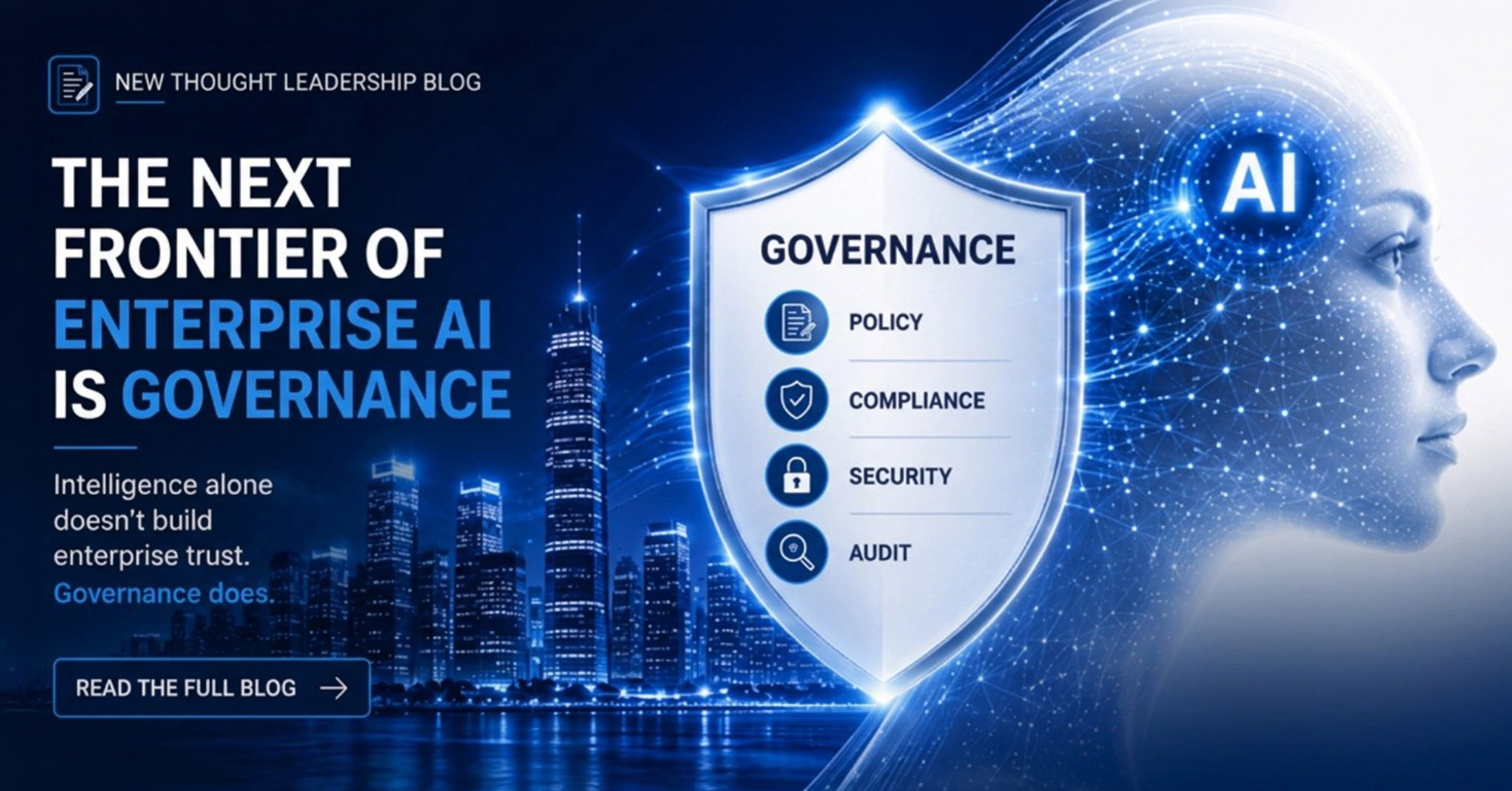
A resilient AI governance framework combines multiple layers of control:
- Identity and Access Management to define what AI is permitted to access and execute.
- AI Guardrails to secure interactions and protect enterprise data.
- Policy Verification to ensure AI-driven actions comply with organizational policies.
- Continuous Monitoring and Audit Trails to provide transparency, accountability, and regulatory readiness.
Together, these capabilities enable organizations to move beyond intelligent automation toward trusted, enterprise-scale AI.
As autonomous AI becomes part of everyday business operations, governance will increasingly determine how confidently organizations can innovate while managing risk.
Conclusion
Enterprise AI is entering an era where autonomous decision-making will become a competitive advantage. But autonomy without governance introduces unnecessary operational and regulatory risk.
The organizations that lead this next phase will not be those with the most intelligent AI alone. They will be those that establish clear governance frameworks, enforce enterprise policies consistently, and ensure every AI-driven action is transparent, accountable, and aligned with business objectives.
INFOLOB's Perspective
At INFOLOB, we believe the future of enterprise AI depends on balancing innovation with governance. As organizations accelerate the adoption of Agentic AI, success will require more than intelligent models it will require governance frameworks that ensure every AI-driven decision aligns with enterprise policies, regulatory expectations, and operational objectives.
By embedding policy verification alongside AI guardrails, security controls, and enterprise governance, organizations can transform AI from an experimental capability into a trusted operational asset enabling innovation at scale while maintaining the confidence, transparency, and accountability that modern enterprises demand.
For all queries, please write to: